August 10,2026
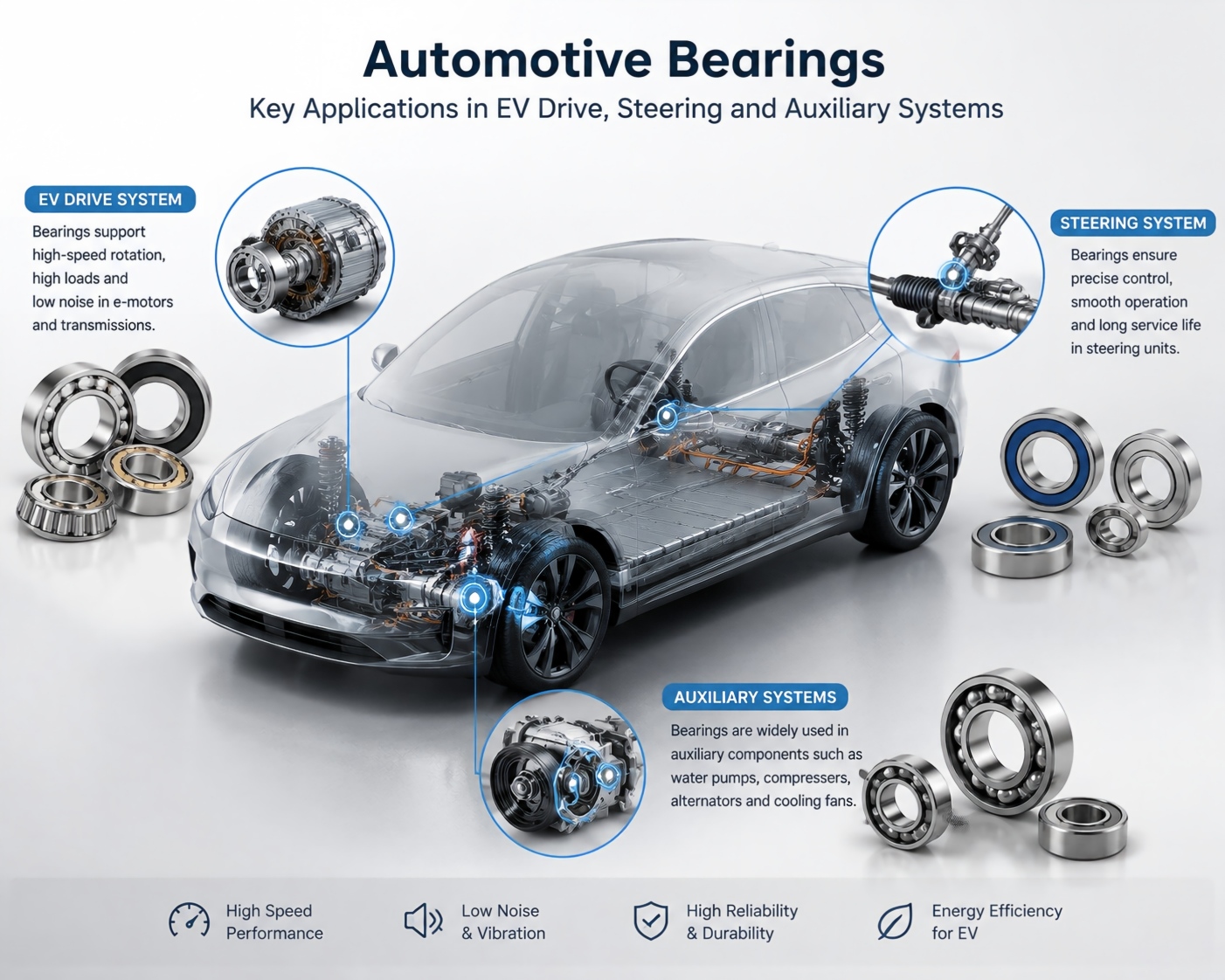
The global automotive bearings industry is undergoing a profound transformation driven by the rapid electrification of vehicle powertrains. As electric vehicles (EVs) and hybrid electric vehicles (HEVs) become mainstream, bearing manufacturers worldwide are racing to develop solutions that meet the unique demands of next-generation mobility.
The global automotive bearings market is entering a pivotal phase in 2026, driven by the accelerating transition toward electrification, increasing vehicle production volumes in emerging economies, and rising demand for enhanced fuel efficiency and durability. Bearings—critical components in engines, transmissions, wheels, and electric drive units—are evolving from simple mechanical parts into highly engineered, sensor-integrated solutions. The market is projected to maintain steady growth, with a compound annual growth rate (CAGR) of approximately 5–6% through 2026, supported by both rising vehicle parc and technological upgrading across all powertrain types.
Total global demand for automotive bearings in 2026 is estimated to exceed USD 45 billion, with unit shipments surpassing 8 billion pieces annually. Key growth drivers include:
Rising vehicle production in recovering post-pandemic supply chains, particularly in China and India.
Increased bearing content per vehicle, as modern architectures require more bearings for auxiliary systems (e.g., electric water pumps, e-turbochargers, and thermal management modules).
Premiumization trends, with OEMs specifying higher-grade bearings (e.g., ceramic hybrid bearings) to reduce friction and extend service life.
OEM (Original Equipment Manufacturer) Segment: Accounts for roughly 60–65% of total market value. In 2026, OEM demand is strongly influenced by new vehicle assembly rates and the ramp-up of dedicated EV platforms. OEMs are increasingly partnering with bearing suppliers early in the design phase to co-develop lightweight, low-noise, and high-speed bearing solutions tailored to e-axles and reduction gears.
Aftermarket Segment: Represents 35–40% of market share. The aftermarket is benefiting from aging vehicle fleets in mature markets (average vehicle age >12 years in the US and Europe), coupled with extended warranty and maintenance programs. However, the rise of EVs—which feature fewer moving parts and regenerative braking—is gradually reducing traditional drivetrain replacement cycles, pushing aftermarket players to diversify into EV-specific maintenance offerings (e.g., wheel hub bearings and motor shaft bearings).
The powertrain mix in 2026 creates distinct bearing requirements:
ICE (Internal Combustion Engine) Vehicles: Still dominate unit volume, but growth is flat. Bearings for ICE applications focus on high-temperature resistance, heavy-load capacity (crankshaft and connecting rod bearings), and durability under combustion stress. Demand is concentrated in emerging markets where ICE adoption remains strong.
HEV (Hybrid Electric Vehicles): Represent a transitional but growing segment (approx. 20% of new sales). HEVs require bearings that handle both engine and motor torque inputs, demanding higher axial load capacity and enhanced sealing to prevent e-motor contamination. Bearings for integrated starter-generators and torque-split devices are key growth areas.
EV (Battery Electric Vehicles): The fastest-growing segment. EV-specific bearings differ significantly:
Operate at much higher speeds (15,000–25,000 RPM vs. 6,000–8,000 RPM for ICE).
Require low friction to maximize battery range.
Demand insulation against electrical arcing (electrostatic discharge) to prevent pitting in motor bearings.
Increasing adoption of sensorized bearings for real-time temperature, vibration, and speed monitoring in e-drive units.
Asia-Pacific remains the largest and fastest-growing regional market, capturing over 50% of global revenue in 2026.
China leads in both EV production and bearing consumption, supported by aggressive government EV mandates and a mature local supply chain. Chinese bearing manufacturers are rapidly upgrading quality to compete with global Tier-1 suppliers.
India shows robust growth, driven by rising middle-class vehicle ownership and a strong domestic aftermarket.
Japan and South Korea remain innovation hubs, with advanced materials and precision manufacturing for high-end bearings used in premium EVs and hybrids.
Europe is the second-largest market, distinguished by its strong emphasis on sustainability, efficiency, and premium vehicles.
Stricter CO₂ emission regulations continue to push OEMs toward lightweight, low-friction bearing designs.
Europe is a global leader in ceramic bearing technology, widely used in high-performance EVs and luxury ICE models.
The region also sees active consolidation among bearing suppliers and OEMs to secure raw material supply (e.g., specialty steel and ceramics) amid geopolitical uncertainties.
Aftermarket demand is stable, supported by a large, well-maintained vehicle fleet and a strong DIY culture in countries like Germany and France.
North America represents a mature but resilient market, driven by the resurgence of domestic EV manufacturing (particularly under the Inflation Reduction Act) and a robust truck/SUV segment.
The US is investing heavily in local battery and e-drive production, creating new demand for bearings tailored to high-torque electric pickups and SUVs.
The aftermarket is significant, fueled by long-distance driving habits and extreme weather conditions that accelerate bearing wear.
Supply chain localization is a major theme in 2026, with North American OEMs actively reducing dependency on Asian suppliers for critical bearing components, encouraging new plant investments in Mexico and the US Midwest.
The automotive bearing industry in 2026 is undergoing a fundamental transformation, driven by the rapid proliferation of electric vehicles (EVs), stricter emission norms, and the pursuit of greater efficiency, durability, and intelligence. Below are the most prominent trends shaping the market this year.
The single most influential trend in 2026 is the accelerating shift toward electrified powertrains. As global EV penetration surpasses 25% of new vehicle sales, bearing suppliers are reorienting their R&D portfolios from traditional internal combustion engine (ICE) applications to electric drive units (EDUs), e-axles, and traction motors. Unlike ICE bearings, which primarily manage combustion-related loads and heat, EV bearings must accommodate:
Higher rotational speeds (up to 25,000 RPM) without compromising thermal stability.
Higher instantaneous torque from electric motors, requiring enhanced load-carrying capacity in compact form factors.
Quieter operation, as the absence of engine noise makes bearing vibration and acoustic performance critical to cabin comfort (NVH).
In 2026, major bearing manufacturers are launching dedicated EV bearing product lines with optimized cage designs, advanced grease formulations, and modified internal geometries specifically engineered for the unique duty cycles of battery-electric and hybrid vehicles.
A critical challenge unique to EV traction motors is electrical pitting—microscopic cratering of bearing raceways caused by stray electric currents passing through the bearing. These currents, generated by pulse-width modulated (PWM) inverter drives, can lead to premature bearing failure if left unaddressed. In 2026, insulation technology has become a non-negotiable feature in EV bearings. Key solutions include:
Ceramic hybrid bearings (silicon nitride rolling elements with steel rings), which inherently block current flow while reducing friction.
Insulating coatings such as plasma-sprayed alumina (Al₂O₃) or polymer layers applied to the outer ring or inner ring.
Conductive grounding rings and shaft grounding brushes used as supplementary countermeasures.
Suppliers are now offering standardized "insulated bearing" families with verified breakdown voltage ratings (>1,000V DC), as OEMs demand guaranteed protection over the vehicle's full lifecycle. This trend is particularly pronounced in the premium EV and commercial EV segments.
With every watt-hour of battery energy being critical to extending EV range, low-friction bearing technology has moved from a "nice-to-have" to a strategic imperative. In 2026, friction reduction is pursued across multiple fronts:
Advanced surface textures: Laser-microtextured raceways that retain lubricant more effectively and reduce boundary friction.
Low-viscosity greases with proprietary anti-wear additives that maintain film thickness while minimizing churning losses.
Optimized cage materials (e.g., polyamide, PEEK) that reduce sliding friction between rolling elements.
Superfinished surfaces with Ra values below 0.02 µm, approaching mirror-like finishes that dramatically lower rolling resistance.
Collectively, these innovations contribute to measurable efficiency gains—some suppliers claim a 2–4% reduction in drivetrain friction losses, which translates directly into extended driving range per charge.
The e-axle—an integrated unit combining motor, gearbox, and inverter—has become the dominant EV architecture in 2026, and its bearings are subject to extreme operating conditions. High-speed e-axle bearings must sustain speeds of 20,000–30,000 RPM while managing high centrifugal forces, elevated temperatures (120–150°C), and limited space. Emerging solutions include:
Ball bearings with smaller-diameter, high-strength balls to reduce centrifugal stress.
Hybrid ceramic designs (ceramic balls + steel rings) to lower inertia and allow higher speed limits.
Oil-jet lubrication systems integrated into e-axle housings to ensure adequate cooling and lubrication at high RPM.
Special heat treatment processes (e.g., carburizing) to maintain dimensional stability under sustained high-speed operation.
In 2026, leading bearing OEMs are co-developing e-axle bearing modules with automotive Tier-1 suppliers, moving from off-the-shelf components to fully engineered system solutions.
Weight reduction remains a top priority across all vehicle types, but especially for EVs, where every kilogram saved contributes to improved efficiency and packaging flexibility. In 2026, lightweight bearing design goes beyond material substitution to include:
Thinner-section rings achieved through advanced finite element analysis (FEA) and high-strength steel grades.
Hollow rolling elements (tubular or drilled balls) that reduce mass by up to 30% without sacrificing load capacity.
Polymer composite cages replacing traditional brass or steel cages, offering weight savings of 40–60%.
Integrated bearing-hub units that eliminate separate flanges and fasteners, reducing overall system weight.
The trend is most advanced in wheel hub bearings and transmission bearings, where unsprung mass reduction directly improves vehicle dynamics and ride comfort.
As EV powertrains operate in cleaner environments than ICE engines (no combustion gases, fewer particulates), one might assume sealing requirements are relaxed. In reality, 2026 reveals a more nuanced picture: seals must now protect bearings from different but equally aggressive contaminants, including coolant ingress, water splash, and fine metallic wear debris from gears and motors. Cutting-edge sealing trends include:
Low-friction radial shaft seals with PTFE (polytetrafluoroethylene) lip materials that reduce drag torque by up to 50% compared to conventional rubber seals.
Integrated magnetic encoder seals that combine sealing and speed-sensing functions in a single compact unit—critical for wheel speed and motor position sensing.
Multi-lip labyrinth designs for e-axle applications, providing redundant protection without increasing frictional losses.
Biodegradable and temperature-stable seal elastomers that withstand the higher underhood temperatures of fast-charging EVs.
Sealing technology in 2026 is no longer a passive barrier but an active contributor to bearing efficiency and system reliability.
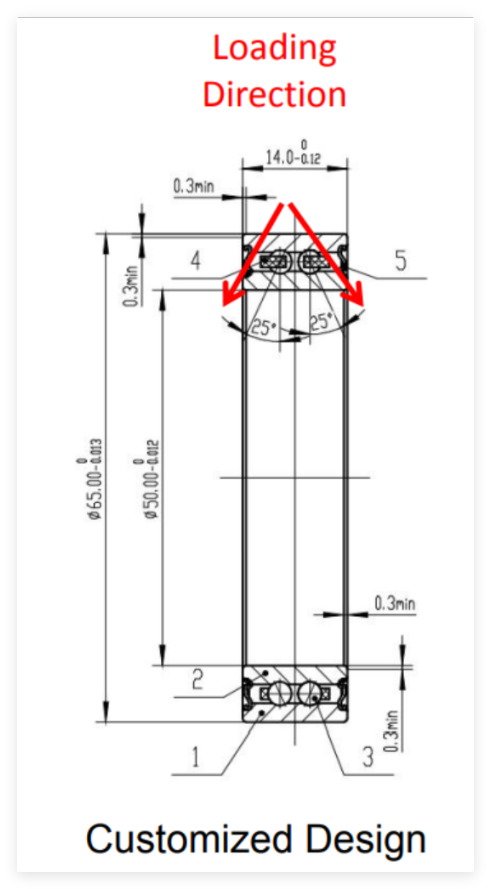
The era of "one-size-fits-all" bearing solutions is ending. In 2026, automotive OEMs are demanding increasingly customized bearings tailored to specific vehicle platforms, powertrain types, and performance targets. This trend is driven by:
Platform-based vehicle development, where a single bearing design must accommodate multiple motor variants, gear ratios, and power outputs.
Differentiated brand positioning—luxury EV brands require ultra-low NVH bearings, while commercial EV fleets prioritize longevity and serviceability.
Unique installation spaces, as compact EV architectures leave little room for standard bearing envelopes.
Bearing suppliers are responding by offering modular design platforms with interchangeable components (cages, seals, greases, and ring materials) that can be rapidly configured for each customer. Advanced simulation tools and AI-driven design optimization enable shorter development cycles—from concept to prototype in weeks rather than months. In 2026, the ability to deliver application-engineered, custom bearings is becoming a key competitive differentiator in the industry.
One of the most critical challenges facing the industry is electrical pitting—a failure mechanism caused by electrical currents passing through bearings in electrified powertrains . As battery systems migrate toward 800V architectures, the risk of electrical damage intensifies, making insulation a critical requirement for EV bearings.
Japanese bearing manufacturer NTN has responded by establishing local production capabilities in China for its Resin Mold Insulated Bearings. These components, which feature an injection-molded resin insulating layer on the outer ring's diameter and width surfaces, offer withstand voltage of 1,000V or more and are compatible with 800V battery architectures . NTN has already begun supplying prototype samples to Chinese customers as of May 2026, with phased mass production expected to follow based on market demand .
NTN has also unveiled a redesigned hub bearing that reportedly reduces rotational friction by approximately 66% compared to its predecessor. Applied to a battery-electric vehicle, this improved seal enhances energy efficiency by 0.76%, translating to approximately 2.2 kilometers of additional range per charge—a meaningful improvement in the competitive EV market .
| Technology | Main Purpose | Typical EV Application |
|---|---|---|
| Resin insulated bearings | Electrical insulation | E-Axle |
| Ceramic insulated bearings | Electrical corrosion protection | High-speed motors |
| Low-friction hub bearings | Reduce rotational losses | EV wheel hubs |
| High-speed bearings | Support high RPM | E-motor / E-Axle |
Technology Benefit
66% lower rotational friction
0.76% improvement in BEV energy efficiency
Up to 2.2 km additional range per charge
For Original Equipment Manufacturers (OEMs) seeking application-specific bearing solutions, standardized catalog offerings frequently fall short of meeting the demands of high-speed operation, harsh environments, compact designs, or extended service life requirements .
MTWB (Mighty Way Industrial Limited), a specialized bearing manufacturer with more than 18 years of experience and support for 100+ OEM customers, has established itself as a partner capable of developing bearings tailored to specific operating conditions . Unlike suppliers focused exclusively on standard products, MTWB supports customers through the complete development process—from technical drawing review and engineering feasibility analysis to prototype development, sample validation, and mass production .
Notably, MTWB developed a customized truck separation bearing solution for Shaanxi Heavy Duty Automobile in 2023, addressing the demanding requirements of high-load operation, frequent engagement cycles, and harsh working environments. Through optimized bearing structure, material selection, and manufacturing precision, these bearings provide stable performance and reduced maintenance requirements . The company has also obtained patent certification for a dual sealing structure that significantly improves sealing performance, preventing lubricant leakage and extending service life .

| Requirement | Why It Matters |
|---|---|
| High rotational speed | Supports high-speed e-motor operation |
| Electrical insulation | Reduces electrical pitting |
| Low friction | Improves vehicle efficiency |
| High temperature resistance | Handles motor and e-Axle heat |
| Low noise and vibration | Improves NVH performance |
| High sealing performance | Protects against grease leakage and contamination |
| Long service life | Reduces maintenance and replacement |
The shift toward electrification has prompted significant investment from established bearing manufacturers. Schaeffler India has announced a 5 billion rupee (approximately 430 million RMB) investment for capacity expansion in fiscal year 2026, with 1.7 billion rupees specifically allocated to automotive technology . Meanwhile, SKF has operationalized its Asia-Pacific headquarters and R&D center in Shanghai with over 200 million RMB invested, partnering with Shanghai Jiao Tong University on advanced bearing testing technologies and smart tool development .
The importance of the automotive bearing aftermarket was prominently on display at Automechanika Istanbul 2026, where numerous bearing manufacturers showcased comprehensive product lines with particular emphasis on aftermarket demand. Industry analysts project the global automotive bearing market will reach between $22.13 billion and several tens of billions of dollars by 2026, with the Asia-Pacific region representing the largest market share .

As the automotive industry continues its transition toward electrification and intelligent manufacturing, MTWB stands ready to support global OEM manufacturers with application-specific bearing solutions. With comprehensive engineering capabilities, advanced manufacturing resources, and a customer-driven approach, MTWB delivers precision bearings optimized for real-world operating conditions.
For more information about MTWB customized bearing solutions—including capabilities in high-speed performance, corrosion resistance, wear resistance, sealing technologies, and extreme condition applications—visit www.mtwb-customized-bearing.com.
For media inquiries, please contact:
Mighty Way Industrial Limited (MTWB)
Email: sales@mtwbearing.com
Website: www.mtwb-customized-bearing.com
Address: Room 13-15, 19/F, Nan Fung Centre, 264-298 Castle Peak Road, Tsuen Wan, N.T., Hong Kong